Jean Anderson's viewpoint might perhaps be one of empathy on many levels. She grew up in Calcutta and is a distinguished alumnus of St Thomas's School, one of the places described at length in the novel. Jean's father was also vice-principal at the same school. Jean now lives in Western Australia, so she can also see the tale from a migrant's point of view. She claims never to have heard the language used by Frank Walker and Wally Bennett in the Jindaroo Creek chapters!
It took me a little while to get started on your book, but once into it I couldn't put it down until the last page. It's been a totally engaging experience reading it, and I congratulate you on your magnificent work.
You've created a marvellously insightful panorama across the two cultures in a way that will surely resonate with migrants of all persuasions - but especially the Anglo-Indians; and the family story threading it all together kept me captivated. I have been carried along with the triple journey motif (in bullock cart, train, jet etc, etc) and your characterisations of the people who pop up along the way (Biplab, for instance -- brilliant -- and the Aussie mates in the outback!).
You have a Dickensian touch in the story of Ismail and Zarina (and Sailen Nath Benerji) - it brings alive the utter pathos that oozes out of the Kolkata kerbstones, and yet you manage to wring some hope and goodness out of all the grime and crime. And then you provide a nice counterpoint with the comedy at Jindaroo Creek.
Your treatment of the social dilemma faced by Steve and Hilary will raise some interesting discussion points for your readers (another dab of Dickens!). Is their adoption story based on some real experiences you've witnessed?
Well, my boy, you're right up there with the best of the post-colonial writers. To sum up : it's a bloody good read!! (See how you've influenced my use of the vernacular...)
Congratulations!!!
Jean Anderson, Perth, Western Australia
Saturday, July 15, 2006


Dude, Where's My Carp?
This is the dawning of the age of Aquariums
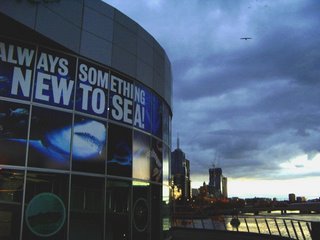 Photo copyright: DAVID McMAHON

Photo copyright: DAVID McMAHON

Photo copyright: DAVID McMAHON
Melbourne is an amazing city to photograph - at any time of the day. The nuances of light and texture are never the same.
These pictures were taken at dawn on a winter morning when the temperature was about five degrees.
The first of the three frames shows the Aquarium, a fairly recent addition to the city, where it is possible to swim with sharks. Probably the highest-profile celebrity to take on that challenge was Formula One driver Ralf Schumacher, before the Melbourne Grand Prix about three years ago.
The second and third pictures were also taken from a little further along the bridge. The second shot is taken while looking across the Yarra from the Aquarium, as the early-morning light formed a shimmering expanse of silver across the river, contrasting with the gray slab of cloud above.
The last of the pictures shows the Aquarium, with part of the skyline in the background, including the famous blue tower called the Rialto, where the viewing deck provides a stunning vista across the city and suburbs.
And while on the subject of Aquariums, why didn't Hollywood think of the simplest title for the film `Finding Nemo', about the adventures of a clownfish - they could have just called it `A Fish Called Wander'.
Thursday, July 06, 2006
Somethin' Fishy Goin' On
Caught - hook, line and sinker
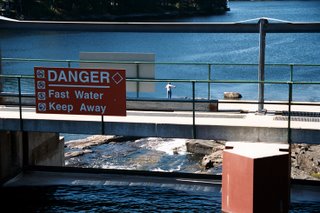 Photo copyright: DAVID McMAHON
The photograph above was taken at Bala, a picturesque little town in Muskoka, northern Ontario. It was mid-afternoon and the weather was perfect. The light was good, the water was blue, the waterfalls were a cascade of frothy white foam. And the bold red sign, with the clear warning, was just another contrast to a serene scene.
But there is another reason I took the photograph. It seems not everyone heeds the warning sign.
Have a look at the picture below, which is a closer crop of the same image.
How do you rate as a hawk-eyed detective? Did you notice the recalcitrant fisherman in the first image?
Hope he caught something - apart from a cold!
 Photo copyright: DAVID McMAHON
Wednesday, July 05, 2006
`Vegemite Vindaloo' - a third email critique
I have finished `Vegemite Vindaloo' and I loved it! I'm not just saying this, because I feel obligated to or something, but I really enjoyed it!
There are books that I buy for my friends and the one I usually buy is by Alexander McCall Smith, "2 and a Half Pillars of Wisdom". It's a really fun book. Well, I think `Vegemite Vindaloo' will also start featuring on my gifting list now ... it's wonderfully warm and funny and sad and I really liked the end!
Steve Cooper sounded a bit too good to be true, but fortunately I have met some really nice people like him, so I do believe those sort of people exist! What I loved the most was the character sketches ... each of them was so full of life. There were so many characters, like the corrupt Customs officer or the small-time crook, who you could just have named and described the events around them, but by drawing them out in such detail they just added a whole new dimension to the story...I absolutely loved it!
The little bits about Air Force life were very accurate as well!
I plan to gift my aunt a copy ... she lives in Melbourne. I think she migrated there about 25 years ago (not sure, but around that much) and I think she'd really enjoy it!
Well, thank you for a really enjoyable read ... I've passed it on to my boyfriend, because he felt terribly neglected while I was reading it so he's decided to see what was so gripping!
Reem Khokar, New Delhi
PR and Marketing Co-ordinator, Rough Guides
There are books that I buy for my friends and the one I usually buy is by Alexander McCall Smith, "2 and a Half Pillars of Wisdom". It's a really fun book. Well, I think `Vegemite Vindaloo' will also start featuring on my gifting list now ... it's wonderfully warm and funny and sad and I really liked the end!
Steve Cooper sounded a bit too good to be true, but fortunately I have met some really nice people like him, so I do believe those sort of people exist! What I loved the most was the character sketches ... each of them was so full of life. There were so many characters, like the corrupt Customs officer or the small-time crook, who you could just have named and described the events around them, but by drawing them out in such detail they just added a whole new dimension to the story...I absolutely loved it!
The little bits about Air Force life were very accurate as well!
I plan to gift my aunt a copy ... she lives in Melbourne. I think she migrated there about 25 years ago (not sure, but around that much) and I think she'd really enjoy it!
Well, thank you for a really enjoyable read ... I've passed it on to my boyfriend, because he felt terribly neglected while I was reading it so he's decided to see what was so gripping!
Reem Khokar, New Delhi
PR and Marketing Co-ordinator, Rough Guides
Good Things Come In Freeze
Just A Couple Of Blocks Away

Photograph copyright: DAVID McMAHON

Photo copyright: DAVID McMAHON
These pictures were taken in a shop called `Christmas Tyme', on Main Street East, in Huntsville, Ontario. I'd never seen anything like the ``Brrr blocks'' in the top picture. As you can see in the second shot, there is nothing like a bit of humour at Yuletide. One of the little signs says: ``Dear Santa, leave presents, take brother''. Another says: ``Dear Santa, define good'' and a third, with the benefit of hindsight, declares: ``Dear Santa, I can Explain''.
Friday, June 30, 2006
Vegemite Vindaloo - an email critique
This email is from a former Calcuttan, Jillian Brand,
who has lived in Switzerland for more than 30 years:
What can I say! Brilliant! Absolutely bloody brilliant! I have enjoyed every single word, every minute of reading `Vegemite Vindaloo', and I was so sorry I finished it today. Give yourself a BIG pat on the back and keep writing!
You totally transported me back to Calcutta – took me back to my youth. I felt cocooned in warm memories made so alive again by your writing. It was amazing how this book made me feel – yes, feel. I could see, smell almost, what you had put into words.
The New Market, where one old coolie would wait for my Mum – he knew when she would be coming and at what time, and he would be waiting. She never took any other coolie – and the patience that man had! The wetness of the Flower Market and the crushed stems everywhere. The Meat Market, where I would hold my breath and run through as quickly as I could, because of the awful smell! Needed to get to the other side, because that was where Mum bought her spices and rice!
What touched my heart and brought tears to my eyes, was your reference to the CEL Fete! This was the Fete of the year. Your Mum and mine, Ivy Bird, Mrs Makin, all bustling around St. Nicholas’s Stall. It was always a beautiful day and I used to love planning what to wear weeks in advance and always, always had a good time. Wonderful memories.
I could go on and on, but then you might think I was writing a book too! I really just wanted you to know how very, very proud I am of you. Well done, and please continue writing – because you are a talented writer and have one BIG fan – me!
Your book shows, in particular, how much you love the city of your birth – Calcutta. It’s not just the places you have mentioned, but your talent lies in opening the box! Creating a picture! Making your readers part of the story. I read quite a lot, but no book has touched me and lingered, as much as your Vegemite Vindaloo. Maybe as it was written about Calcutta, the city I too loved, this obviously plays a large part, but there was something more, and I think it lies in your story telling.
You have awakened, through your writing, a place inside me that I haven’t visited for a very long time. As we reach adulthood, Life takes over and with all its trials and tribulations; one very often forgets the warm, peaceful place inside ourselves that is our Retreat, and this place you have given back to me. Thank you. Don’t mean to sound soppy – but it’s exactly how I feel.
I felt totally involved with the characters right up to the end of the book, and when I realised there were only 4 more pages to go, I thought “oh, no – there has to be a sequel, a continuation, another book carrying on the story of Azam. What happened to him, his family in India, ? This can’t be the end”. To begin with, I was quite upset that the book ended as it did!
Then, as you so rightly hoped, I did go back to the beginning of the book, and realised who the football hero was! All was then clear! You achieved what you wanted – something unique. Still didn’t stop me from being disappointed that I had finished the book!
One of the cutest touches you put in was Phillip! “Yeah, men”, “… now I’m on my turd”! Oh, how I laughed! I could just imagine the accent as well! The other of course – perfect – was “soo-soo”!!!!!! And thanks too for the whole of “nini baba nini, makhan roti chini …!! I knew these two lines, but not the rest, now I can sing the full rhyme to my grandson. He’s been short changed till now!
I think every A.I. home should have a copy of your book in pride of place. When I visit India next January, I’ll get some more copies for my friends and I am sure they will enjoy it as much as I have. I’m not parting with my copy.
Jillian Brand, Switzerland
who has lived in Switzerland for more than 30 years:
What can I say! Brilliant! Absolutely bloody brilliant! I have enjoyed every single word, every minute of reading `Vegemite Vindaloo', and I was so sorry I finished it today. Give yourself a BIG pat on the back and keep writing!
You totally transported me back to Calcutta – took me back to my youth. I felt cocooned in warm memories made so alive again by your writing. It was amazing how this book made me feel – yes, feel. I could see, smell almost, what you had put into words.
The New Market, where one old coolie would wait for my Mum – he knew when she would be coming and at what time, and he would be waiting. She never took any other coolie – and the patience that man had! The wetness of the Flower Market and the crushed stems everywhere. The Meat Market, where I would hold my breath and run through as quickly as I could, because of the awful smell! Needed to get to the other side, because that was where Mum bought her spices and rice!
What touched my heart and brought tears to my eyes, was your reference to the CEL Fete! This was the Fete of the year. Your Mum and mine, Ivy Bird, Mrs Makin, all bustling around St. Nicholas’s Stall. It was always a beautiful day and I used to love planning what to wear weeks in advance and always, always had a good time. Wonderful memories.
I could go on and on, but then you might think I was writing a book too! I really just wanted you to know how very, very proud I am of you. Well done, and please continue writing – because you are a talented writer and have one BIG fan – me!
Your book shows, in particular, how much you love the city of your birth – Calcutta. It’s not just the places you have mentioned, but your talent lies in opening the box! Creating a picture! Making your readers part of the story. I read quite a lot, but no book has touched me and lingered, as much as your Vegemite Vindaloo. Maybe as it was written about Calcutta, the city I too loved, this obviously plays a large part, but there was something more, and I think it lies in your story telling.
You have awakened, through your writing, a place inside me that I haven’t visited for a very long time. As we reach adulthood, Life takes over and with all its trials and tribulations; one very often forgets the warm, peaceful place inside ourselves that is our Retreat, and this place you have given back to me. Thank you. Don’t mean to sound soppy – but it’s exactly how I feel.
I felt totally involved with the characters right up to the end of the book, and when I realised there were only 4 more pages to go, I thought “oh, no – there has to be a sequel, a continuation, another book carrying on the story of Azam. What happened to him, his family in India, ? This can’t be the end”. To begin with, I was quite upset that the book ended as it did!
Then, as you so rightly hoped, I did go back to the beginning of the book, and realised who the football hero was! All was then clear! You achieved what you wanted – something unique. Still didn’t stop me from being disappointed that I had finished the book!
One of the cutest touches you put in was Phillip! “Yeah, men”, “… now I’m on my turd”! Oh, how I laughed! I could just imagine the accent as well! The other of course – perfect – was “soo-soo”!!!!!! And thanks too for the whole of “nini baba nini, makhan roti chini …!! I knew these two lines, but not the rest, now I can sing the full rhyme to my grandson. He’s been short changed till now!
I think every A.I. home should have a copy of your book in pride of place. When I visit India next January, I’ll get some more copies for my friends and I am sure they will enjoy it as much as I have. I’m not parting with my copy.
Jillian Brand, Switzerland
Thursday, June 22, 2006
`Vegemite Vindaloo' - a friend's viewpoint
This email is from a childhood friend of mine. She's given me a bit of a kicking, as you'll see. But she's bought seven copies of the book and that's what counts.
Finished the book within 36 hours. My Parsi friend Perri says she hunted for it in Mumbai and couldn't get a copy so I bought it here in Crossword. See, I'm spreading the word according to McMahon.
Now for my review. Remember NOT to pay any attention to "critics" - they're the ones who never wrote a book in theier lives for fear of criticism. As a friend, I found the book unashamedly nostalgic. Imagine weaving into the tale the "smell of ALOA" on Kydd Street. It's the same by the way, went down there the other day.
I liked the portrayal of Ismail and family --- very nicely done. I liked the way you introduce them into Cal and their meeting up with the Coopers and all their troubles and tribulations. The details were great and the situations realistic and beautifully protrayed. I liked "fatty Ayah".
Steve Cooper has so much going for him and you make him "fizzle" out in Oz and he becomes a capitalist pilot! I mean here is this guy, who if I had known him, or rather if he existed, I would have given up all intentions of staying single and married him, but then in the way of all men he just fizzles out.
His attachment to Azam and the way he deals with it is beautiful. His time in Oz is, I don't know, unremarkable. I somehow had hoped that he would join the two mad guys in Jindaroo Creek, but you're the story teller and I'm the critic! The old man Wally Bennett is an interesting character. He would fit in beautifully into a "cameo role" when the book becomes a movie.
Hated the beginning. It's all right till the two men met but the rest of the bit about football had me turning pages. The end ties up nicely with the beginning but the footy details did not appeal. Also the Hindi-filmi style in which Steve Cooper gets a job with Quantas --- too maach man!
Now can anyone get more critical than this?
Dr Ishika Ghose, Calcutta
Finished the book within 36 hours. My Parsi friend Perri says she hunted for it in Mumbai and couldn't get a copy so I bought it here in Crossword. See, I'm spreading the word according to McMahon.
Now for my review. Remember NOT to pay any attention to "critics" - they're the ones who never wrote a book in theier lives for fear of criticism. As a friend, I found the book unashamedly nostalgic. Imagine weaving into the tale the "smell of ALOA" on Kydd Street. It's the same by the way, went down there the other day.
I liked the portrayal of Ismail and family --- very nicely done. I liked the way you introduce them into Cal and their meeting up with the Coopers and all their troubles and tribulations. The details were great and the situations realistic and beautifully protrayed. I liked "fatty Ayah".
Steve Cooper has so much going for him and you make him "fizzle" out in Oz and he becomes a capitalist pilot! I mean here is this guy, who if I had known him, or rather if he existed, I would have given up all intentions of staying single and married him, but then in the way of all men he just fizzles out.
His attachment to Azam and the way he deals with it is beautiful. His time in Oz is, I don't know, unremarkable. I somehow had hoped that he would join the two mad guys in Jindaroo Creek, but you're the story teller and I'm the critic! The old man Wally Bennett is an interesting character. He would fit in beautifully into a "cameo role" when the book becomes a movie.
Hated the beginning. It's all right till the two men met but the rest of the bit about football had me turning pages. The end ties up nicely with the beginning but the footy details did not appeal. Also the Hindi-filmi style in which Steve Cooper gets a job with Quantas --- too maach man!
Now can anyone get more critical than this?
Dr Ishika Ghose, Calcutta
Thursday, June 15, 2006
One Good Churn Deserves Another
Milking it for all it's worth

Photo copyright: DAVID McMAHON
It was a vivid splash of colour on a rainy, grey afternoon in the little town of Gravenhurst, in Muskoka, Canada. I drove in, found a parking spot and got myself organised, with plenty of time to spare, as I was booked on a cruise on the RMS (Royal Mail Ship) Segwun. The cruise is one of the top tourist atttractions in Canada, so I ensured I had plenty of time up my sleeve. I walked down the street, within sight of the wharf where the historic Segwun and her sister vessel, the Wenonah, were berthed. I spent about half an hour shooting film and digital photographs - despite the persistent rain, low cloud and bad light. (Hey, isn't that the real challenge when you're shooting outdoors?) Then I walked up to this antique shop, drawn to the bright array of milk churns lined up on an old wagon. I guess it just goes to show that if you're willing to brave the elements, there's always an unusual shot just around the corner.
Saturday, June 10, 2006
Sittin' On The Dock Of The Day
Witnessing the real Delta force

Port Carling, Canada. Photo copyright: DAVID McMAHON
On reflection, I was rather pleased with this photograph, taken on the main dock of the Delta Sherwood in Port Carling, Canada. I'd been shooting a dramatic sunrise over the lake when the light started to change and I swung my lens to the right, to capture the splendid colours of the silver birch, yellow birch, spruce and pine reflected in the still water around the boathouse. By the way, look to the left of the frame and you'll see a diving platform. It looked inviting, but the level of the mercury made me think twice about swimming to it.
Monday, May 29, 2006
There Is Nothing Like A Dome
Seeking your station in life
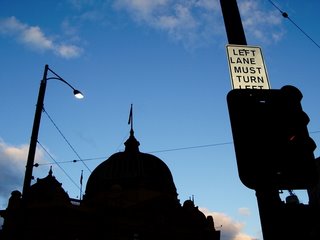
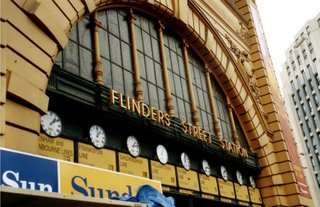
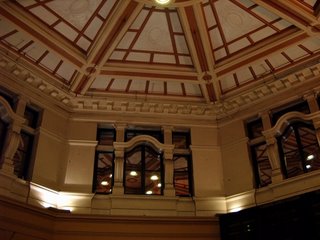
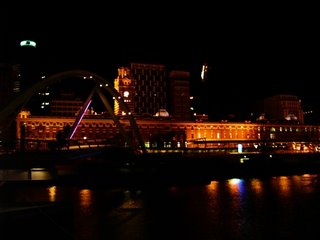 Photo copyright: DAVID McMAHON
And finally, this shot was taken on the south bank of the Yarra, just to give you an idea of the station's size, stretching an entire city block. Its distinctive glow in the dark is a comfortingly familiar sight to Melburnians, as is the reflection in the chilly waters of the Yarra, the other great landmark of the city.
Photo copyright: DAVID McMAHON
This is the famous dome of Flinders Street station, the hub of Melbourne's train system. I shot this picture on a freezing morning, with the dome and a set of traffic lights silhouetted against an icy-blue sky.
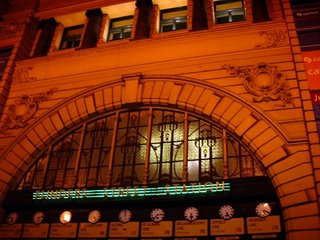 Photo copyright: DAVID McMAHON
This was shot inside the station, under the huge cupola. This graceful arch, across the main entrance, spans the famous clocks showing the times of the trains on the various lines that serve this amazing city.
Photo copyright; DAVID McMAHON
And this picture was shot from just outside the station. These clocks are literally a part of the city's heritage, because in the days before mobile phones, people simply used to arrange to meet ``under the clocks''. I guess you could say that was a case of time standing still.
Photo copyright: DAVID McMAHON
And this shot was taken inside the station, showing the recently refurbished roof and the graceful lines, reminiscent of the colonial era, of the station's interior. I have showed this picture to a lot of my friends who commute regularly through Flinders Street station and most of them said they had never looked up to take notice of the amazing roof.
Photo copyright: DAVID McMAHONAnd finally, this shot was taken on the south bank of the Yarra, just to give you an idea of the station's size, stretching an entire city block. Its distinctive glow in the dark is a comfortingly familiar sight to Melburnians, as is the reflection in the chilly waters of the Yarra, the other great landmark of the city.
Saturday, May 20, 2006
No Malice In Wonderland
Finding the appropriate formula

Narain Karthikeyan in Melbourne. Photo copyright: DAVID McMAHON

The Indian flag: not part of his racing helmet. Photo copyright: DAVID McMAHON
It's been a strange 18 months for Narain Karthikeyan, the first Indian driver on the Formula circuit. He made his F1 debut for the Jordan team at the Melbourne Grand Prix in March last year, but is now a test driver after the shuffle in ownership and team branding.
He even ran into controversy over his design for a racing helmet, featuring the Indian tricolour and the chakra on the top of the helmet. No, he was told by the Indian authorities, he could not display the national flag in such a manner, even if his motives were purely patriotic.
Just before his historic Melbourne debut, I asked him where his obsession with cars really began. Like most Indian lads, did he lean how to drive on an Ambassador, the Indian-made clone of the English mid-1950s Morris Oxford?
He chuckles. ``Yes,’’ he says. But he’s keeping his cards close to his chest. He doesn’t give much away. It’s as if he’s enjoying the cat-and-mouse character of this interrogation.
Was it his father’s car? Affirmative, he says. And, like most Indian petrolheads, did he learn how to use the unforgiving clutch and awkward gear lever long before he reached the legal driving age? Correct, he concedes. He doesn’t give much away, this bloke.
Somewhere in the world, there’s a poker school waiting for Narain Karthikeyan.
Then he cracks. The pressure’s too much for him. ``I might have been about nine or ten years old at the time,’’ he volunteers, his eyes shining.
His father’s car? Yes. Did he get caught? Yes. Often? Yes. Did any of the consequences dissuade him from his love of driving? Er, no.
There’s a couple of other people in the room now, so we’re carrying on this conversation across them. Did he have a teacher who despaired at his obsession with cars? Of course, he admits, laughing.
The teacher told him that driving cars, in essence, would get him nowhere. The teacher wanted him to study, go to university, get a real job.
And does he ever bump into the teacher? Now he’s so animated, the words are rushing out.
After he was given the break of a lifetime, when Jordan signed him to their Formula One team, he caught up with his former teacher. Both former pupil and former teacher obviously enjoyed the irony of how wrong the advice was and how endless prospects now loomed on Karthikeyan’ horizon.
I have one final question for him. Did he bear any ill feelings against his old teacher? No, is the quick answer. Not at all.
There’s no malice in wonderland.
If you'd like to read my interview-based feature with Narain Karthikeyan, just click on this link titled RACE AGAINST TIME? featured on the Anglo-Indian Portal.
Friday, May 12, 2006
Bar, Bar, I'm The Black Sheep
(We'll drink to that - NOW!)

For a bloke who doesn't drink, I seem to spend a lot of my time in pubs. But did I ever tell you about the time I was in the Yukon, in Canada?
There I was, in the Gateway Lounge, one of two pubs in the stunning town of Haines Junction, on the Alaska Highway. And I had to get out my sketch pad while everyone else got acquainted with Canadian grog. Sketch pad? Yup. Because I'm a Darjeeling boy, accustomed to the sight of majestic mountains. And there, through the windows of the pub, were snowy mountains as far as the eye could see.
I have to admit, the hardest part of the sketch was doing the Budweiser sign backwards. I had barely finished the sketch when a big (and I mean B I G) bloke called Rich ambled over to become my best friend. After we'd had a bit of a yarn, he offered to introduce me to squaw wrestling.
I have this mental picture of being forced to fight him for a woman and I look for a dark corner of the Lounge. But Rich pulls one of his mates into the spotlight. ``Here, we'll show you what squaw wrestling is all about.'' He and his mate lie flat on their backs, their heads pointing in opposite directions.
On the count of three, they both raise their right legs as each contestant tries to pin the other down. No contest. Rich has his mate pinned in a couple of seconds. His mate is a woman called Deb.
We get the distinct impression she is very disappointed with her form.
It is my turn. The hopes and fears of our great nation rest on my shoulders. We line up and I formulate the perfect plan. I'll go for his hamstring. One, two, three. I swing up and even before I can swivel, Rich has me pinned. Time elapsed: about half a second. Deb looks a bit happier now.
I'm sorry I don't have any sketches of the squaw wrestling, but the best excuse I can think of is that I lost my pencils. But that would have been the perfect cue for a Shakespearean twist. You know: ``2B or not 2B - that is the question''.
If you'd like to read my teetotaller's guide to Alaskan pubs, just click on this link Anglo-Indian Portal
Saturday, May 06, 2006
Lock, Stock and Barrel
(A couple of trigger-happy competitors)

Olympians Russell Mark and Lt Col Raj Rathore. Photo copyright: DAVID McMAHON
 Lt. Col Raj Rathore at Lilydale. Photo copyright: DAVID McMAHON
These two distinguished Olympians would have to be the Odd Couple of international shooting. Like the incomparable Felix Unger and Oscar Madison, each is the complete antithesis of the other. Russell Mark is a knockabout Aussie, while India's Lt Col Rajyavardhan Rathore (``Chilly'' to his mates, because he's so cool under pressure) is a straitlaced, serious sort of bloke.
Between them, they boast three Olympic medals. The Aussie won a gold medal at the 1996 Atlanta Olympics, then a silver at the Sydney Olympics. The Indian army officer, on the other hand, won a silver medal at the 2004 Athens Games, the first Indian to win an individual silver medal.
But does Rathore, with his parade-ground grooming, know about the Aussie Salute? No, he confesses. Got him.
Then I give him the simple explanation that the Aussie Salute is simply the act of using one hand to brush the flies away from your face on a hot day.
So, who's the big shot now?
If you'd like to read my full-length feature article on Russell Mark and Raj Rathore, with pictures taken at the Lilydale Gun Club in Melbourne, just click on this link Anglo-Indian Portal
Monday, May 01, 2006
Like A Bridge Over Dappled Water
(Apologies to Messrs Simon and Garfunkel)

This was taken at The Spit, on our way back from Sea World on the Gold Coast. I had actually stopped to take some other pictures, when I walked back to the car and noticed the scene in front of me.
The clouds had rolled in, the light had started to fade dramatically. The water was rippling gently and the reflection of the lights on the bridge were casting shadows of liquid gold below, as the pelicans swam past in a serene squadron. Just a nice meld of colours and a picture that simply had to be taken.
And my learned friend and colleague Andrew Rennie, a former Queensland resident, had this nugget of information to add:
``Your picture of the Southport Bridge reminded me of a story I heard when I was visiting the area. One February in the late 1960s, during a particularly torrid storm season and a king-tide period, the Southport Bridge actually went under.
``It was particularly traumatic for the canal-front residents, many of whom had not long finished building their homes. Many houses also went under and insurance companies would not cover the loss.
``If you've ever been around the canals, you will see now that most of the homes are at least two-storey. Regulations dictate that they must be. The only single-level dwellings are those that survived the weather.
``The way property prices are rising on the Coast, it won't be long before these little bastions of a bygone era go the way of the Southport Bridge and get swallowed up too.
``The pelican pictures also brought to mind a story that had Gold Coasters at odds for some weeks back in 2004. A popular Labrador seafood store's ritual of feeding flocks of pelicans was popular with both tourists and locals, but some residents complained the birds' pooing was contaminating the Broadwater and wanted the practise banned.
``The saga dominated the `Gold Coast Bulletin' for days, until finally the Environment Minister Dean Wells, bowing to public pressure, declared the case closed. Normality returned, and the pelicans continue to have a daily feed, much to the delight of the thousands of tourists who flock there each week.''
Photo copyright: DAVID McMAHON
This was taken at The Spit, on our way back from Sea World on the Gold Coast. I had actually stopped to take some other pictures, when I walked back to the car and noticed the scene in front of me.
The clouds had rolled in, the light had started to fade dramatically. The water was rippling gently and the reflection of the lights on the bridge were casting shadows of liquid gold below, as the pelicans swam past in a serene squadron. Just a nice meld of colours and a picture that simply had to be taken.
And my learned friend and colleague Andrew Rennie, a former Queensland resident, had this nugget of information to add:
``Your picture of the Southport Bridge reminded me of a story I heard when I was visiting the area. One February in the late 1960s, during a particularly torrid storm season and a king-tide period, the Southport Bridge actually went under.
``It was particularly traumatic for the canal-front residents, many of whom had not long finished building their homes. Many houses also went under and insurance companies would not cover the loss.
``If you've ever been around the canals, you will see now that most of the homes are at least two-storey. Regulations dictate that they must be. The only single-level dwellings are those that survived the weather.
``The way property prices are rising on the Coast, it won't be long before these little bastions of a bygone era go the way of the Southport Bridge and get swallowed up too.
``The pelican pictures also brought to mind a story that had Gold Coasters at odds for some weeks back in 2004. A popular Labrador seafood store's ritual of feeding flocks of pelicans was popular with both tourists and locals, but some residents complained the birds' pooing was contaminating the Broadwater and wanted the practise banned.
``The saga dominated the `Gold Coast Bulletin' for days, until finally the Environment Minister Dean Wells, bowing to public pressure, declared the case closed. Normality returned, and the pelicans continue to have a daily feed, much to the delight of the thousands of tourists who flock there each week.''
Thursday, April 27, 2006
To Infinity And Beyond
Maths? No, it's a sign of the times
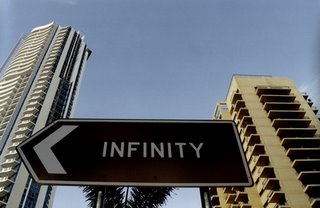 Photo copyright: DAVID McMAHON
We were in Queensland on holiday when I saw this great street sign on the Gold Coast.
So where was the sign pointing to? A mathematicians' conference? Some sort of lateral thinkers' club? A beach with never-ending sand, wonderful crashing surf and magical sunshine that lasted around the clock?
Or was it some sort of museum devoted to the `Toy Story' and `Toy Story 2' movies, so well known for the character of Buzz Lightyear and his catchphrase, ``To infinity and beyond''?
Alas, it was all rather prosaic. The sign pointed to a nightclub.
Still, I had to take the photograph, simply because it was so unusual. So I drove off at 7am on a warm April morning, parked down a side street and found my way to the sign. I had to walk a few metres down a narrow median strip, with cars on either side of me, to take this shot with my film camera.
It's a perfect Gold Coast reminder. Clear blue sky, not tainted by a single cloud. Towering high-rise condos. And the mandatory palm tree, slap-bang in the middle of the frame.
And to all the drivers who thought I was completely mad for venturing onto the slender median strip, my humble apologies. I'm just a crazy southerner from chilly Melbourne.
Doesn't that explain it all?
Thursday, April 20, 2006
This Is No Jumbo Jest
(Seeing eye-to-eye with a bull elephant)

Photo copyright: DAVID McMAHON
The photograph above was taken at the Elephant Safari Park in Bali, Indonesia, in January 2000. No long lens. No telephoto gizmos.
I should also point out that it is not a cropped frame. Nor has the image been digitally enhanced in any way.
Just me, a camera and an elephant.
Techinically, not a great picture, but hey, when was the last time you got so close to an elephant? This was the third or fourth in a series of shots and he was just starting to spark up and show an interest in the mechanical noises that the camera was making.
And me? I was just trying not to breathe too loud, just to ensure I didn't do anything to annoy the old fella.
By this time, he was looking pretty much straight at me and it's a little bit disconcerting when an animal fixes its beady little eyes on you. I'm no mahout, and I wasn't game to try his patience.
Time to get outta there? Eye, eye, sir.
Saturday, April 15, 2006
Not A Plain Old Nullarbor
(This really is a land of sweeping planes)
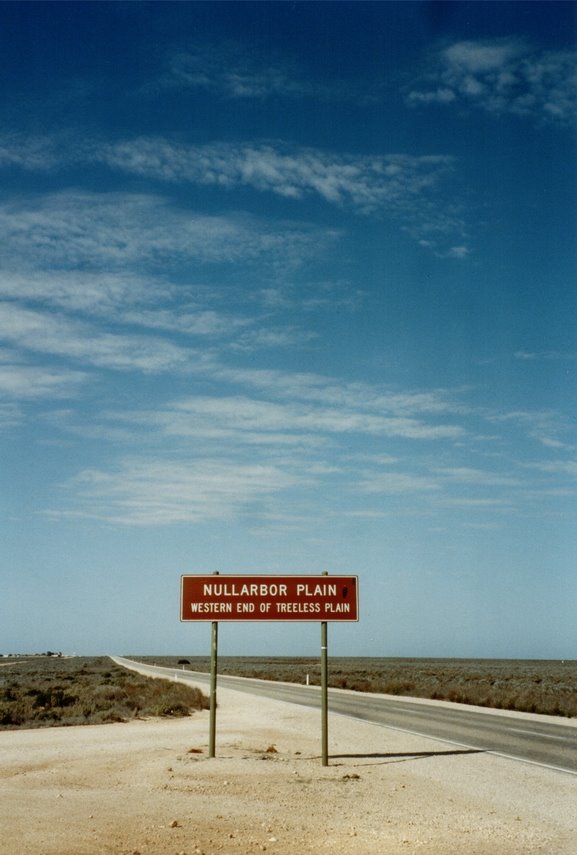
 Australia's Nullarbor Plain gets its name not from an explorer called Mr Nullarbor, it gets its name from the combination of two Latin words ``nullius'' and ``arbor'' meaning ``no trees''.
And they're not kidding. There really are no trees.
There are no tree surgeons on the Nullarbor. In fact, there's not much on the Nullarbor. Nothing apart from stunning desert flowers could possibly grow in such an arid expanse.
If you're driving across the Nullarbor, you need to pay attention to the signs that tell you where the next service station is, because it's not the sort of place you'd want to run out of fuel. No, not even in the month of April, when you could blame it on the undeniable fact that it's April Fuels Day.
It is a vast, treeless plain that can be as daunting as it is starkly beautiful.
You wouldn't want to lose your bearings anywhere on the Nullarbor, simply because there are no significant geographical features.
 I once took a series of pictures encompassing the full 360 degrees from where I stood near a white four wheel drive. The first photograph in the series showed the open right-hand passenger door of the 4WD, just for a point of reference. The earth was red and flat. The scrub was a combination of brown and dark green and no more than ankle high. The sky was cloudless, spanning every shade of blue conceivable, like a giant paint palette.
Every picture in the series looked the same. If the negatives themselves hadn't been in a numbered sequence, I would never have known what the correct order was. There are no geographical clues. The last picture in the sequence has the white 4WD in it once more.
That's why I've used two easily distinguishable pictures with this post. The one above, taken by me in September 1999, shows a signpost for the Nullarbor Plain.
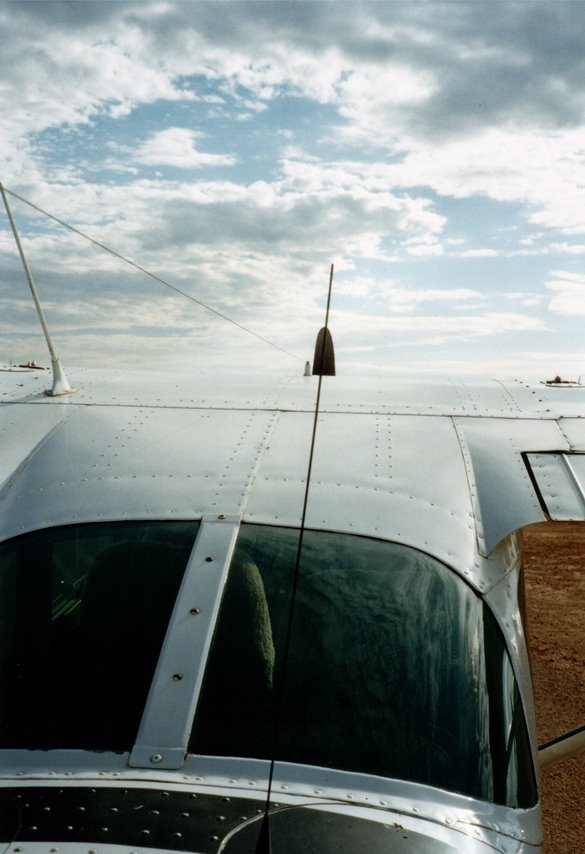
And what about the second picture, which I took during the same trip? Ah, that must be the Nullarbor Plane.
 Australia's Nullarbor Plain gets its name not from an explorer called Mr Nullarbor, it gets its name from the combination of two Latin words ``nullius'' and ``arbor'' meaning ``no trees''.
And they're not kidding. There really are no trees.
There are no tree surgeons on the Nullarbor. In fact, there's not much on the Nullarbor. Nothing apart from stunning desert flowers could possibly grow in such an arid expanse.
If you're driving across the Nullarbor, you need to pay attention to the signs that tell you where the next service station is, because it's not the sort of place you'd want to run out of fuel. No, not even in the month of April, when you could blame it on the undeniable fact that it's April Fuels Day.
It is a vast, treeless plain that can be as daunting as it is starkly beautiful.
You wouldn't want to lose your bearings anywhere on the Nullarbor, simply because there are no significant geographical features.
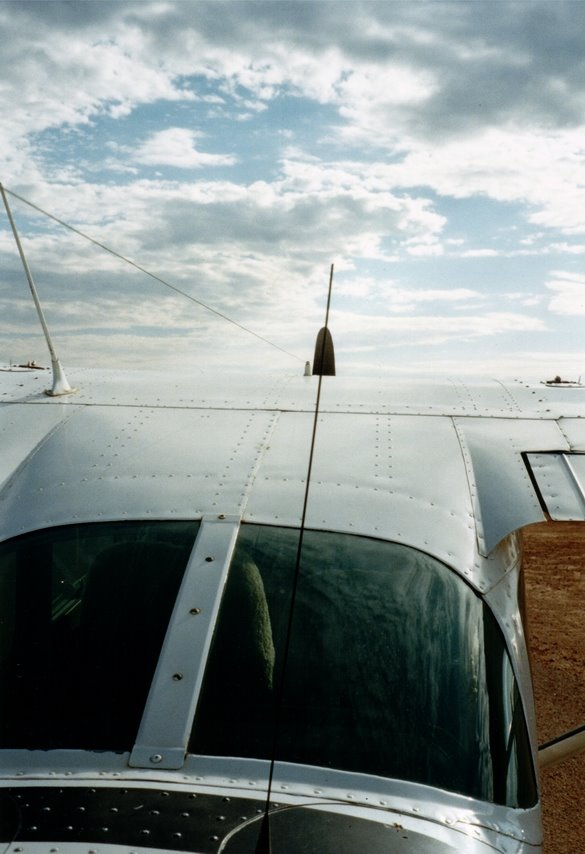
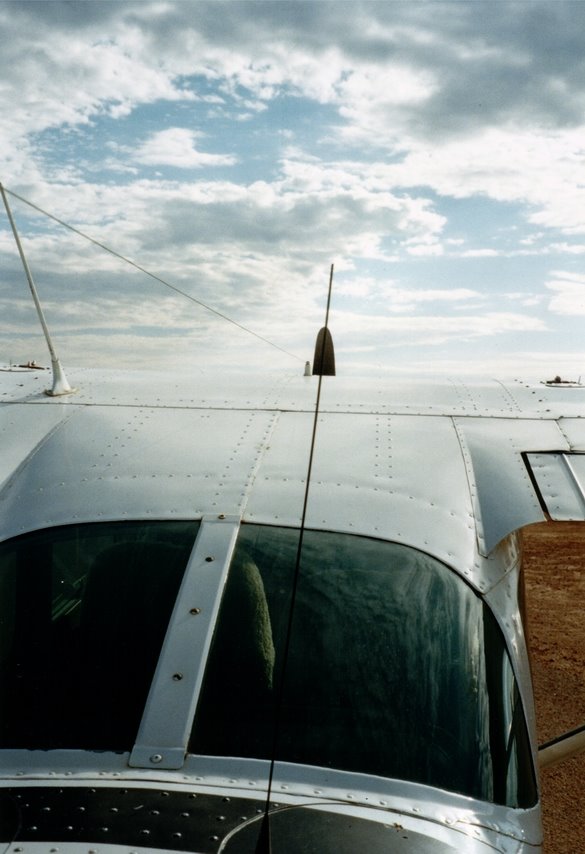
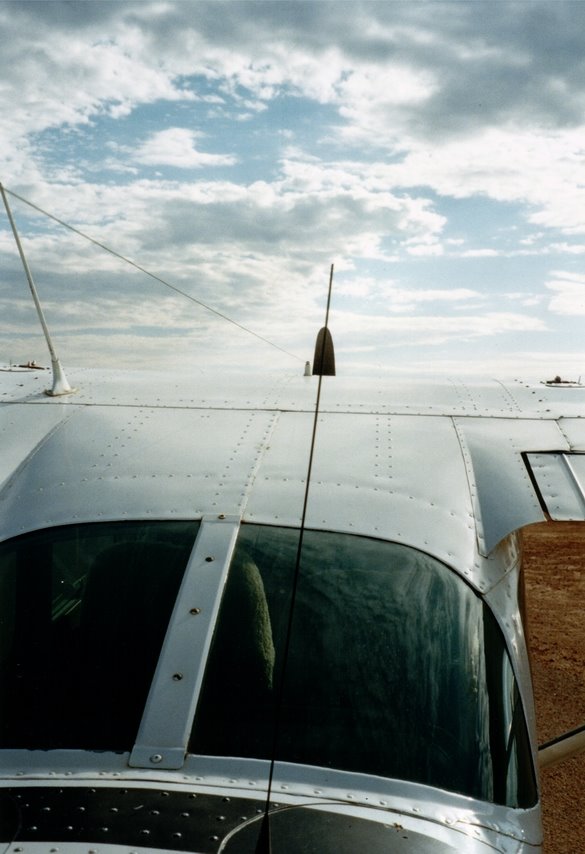 I once took a series of pictures encompassing the full 360 degrees from where I stood near a white four wheel drive. The first photograph in the series showed the open right-hand passenger door of the 4WD, just for a point of reference. The earth was red and flat. The scrub was a combination of brown and dark green and no more than ankle high. The sky was cloudless, spanning every shade of blue conceivable, like a giant paint palette.
Every picture in the series looked the same. If the negatives themselves hadn't been in a numbered sequence, I would never have known what the correct order was. There are no geographical clues. The last picture in the sequence has the white 4WD in it once more.
That's why I've used two easily distinguishable pictures with this post. The one above, taken by me in September 1999, shows a signpost for the Nullarbor Plain.
And what about the second picture, which I took during the same trip? Ah, that must be the Nullarbor Plane.
Saturday, April 08, 2006
All Roads Lead To Chrome
(The winner of the Easter bonnet contest)

Photo copyright: DAVID McMAHON
At Movieworld on the Gold Coast, in the sunny Australian state of Queensland, you can’t miss this sight. In the main square, where the daily parades command the attention of young and old alike, is this vintage DeSoto taxi.
Its sweeping lines and bold design hark back to a long-forgotten era in automotive design. The bonnet itself is high and imperious, almost like the upturned keel of a racing yacht.
As I reached for my camera, I faced a slight dilemma. It was early on an April afternoon and the light was harsh. I needed to find an angle that would capture the car’s majesty, while emphasising the sheer length of that amazing bonnet.
It’s one thing training your lens on a mass-produced Ford Falcon or a Holden Commodore; it’s quite another when you are confronted with a car with this sort of engineering pedigree.
There’s a great yarn from the DeSoto archives that I must narrate here, simply because it says so much about maverick thinkers and the willingness, in the heyday of the automobile industry, to encourage people to think outside the square.
If ideas are the lifeblood of any company, then the story of this publicity stunt by US carmaker DeSoto will always stand out. In 1933, racing driver Harry Hartz drove a DeSoto across the United States … in reverse!
While I could not locate medical records to support my theory that Hartz must have had a terrible crick in his neck at the end of his project, the DeSoto people were not just content to stop and congratulate themselves over the publicity.
Engineers studied the data from Hartz’s amazing drive and soon confirmed that the car’s fuel efficiency was greater when driven backwards. This led to a complete re-evaluation of car design, in the quest for greater speed, better styling … and of course, a greater share of the market.
Which just proves the commercial value of, um, reverse psychology.
Saturday, March 11, 2006
Edifice Complex
(Where in the world is this building?)
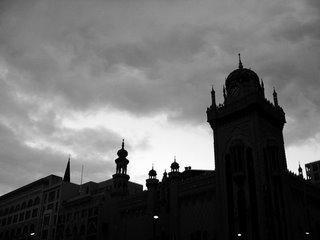
Photo copyright: DAVID McMAHON
This photograph was taken just before sunrise in one of the world's most beautiful cities. But can you identify the building and do you know (or can you guess) which city this is?
Prague, perhaps, with its stunning architecture and striking skyline? Or is it Paris, where every street corner leads you to beautiful buildings and immaculate gardens? Or Istanbul, maybe, judging by the amazing minarets?
None of the above. The photograph was taken on Flinders Street, in Melbourne. The building is the State Theatre, now called the Forum. It was built as one of a series of so-called ``million-dollar theatres'' an ambitious project announced in 1921 by Union Theatres. According to historical records kept by the architect, Charles Bohringer, staff worked day and night and the drawings for the theatre were completed in the unimaginable time of one month.
The theatre's Wurlitzer organ was the real showpiece of the splendid building. The newspaper `The Argus' reported (a trifle breathlessly) that the organ cost the princely sum of twenty-five thousand pounds sterling - a king's ransom at the time. Its arrival at the Melbourne docks was nothing short of a sensation and it was transported from the wharf to the building site in no fewer than 27 trucks, each of which was emblazoned with a large notice (welcome to the age of advanced marketing strategy) saying it contained components of the Wurlitzer organ for the State Theatre.
There was an interesting footnote to this event. Because all the trucks had to travel in a convoy from the docks to Flinders Street, all other city traffic (such as it was at the time) was reduced to chaos until each truck had been unloaded and driven away from the precinct. In high dudgeon, the City Council proceeded to slap the maximum fine on the State Theatre management - for traffic obstruction!
Thursday, February 16, 2006
Drawing On A Great Experience
(Hoots, Mon - which celebrity sketched this owl?)

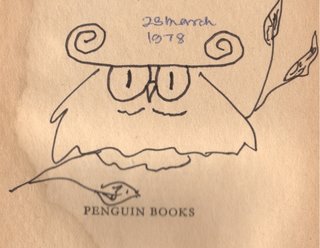
YOU could, I suppose, call it `The True Tale of My Family, Gerald Durrell and Other Animals'.
The owl above was sketched for me in 1978 by the late Gerald Durrell, the best-selling author and naturalist who was born in Jamshedpur, India, in 1925 and died in 1995.
Having spent part of my own Indian childhood chuckling over his books `My Family and Other Animals’, `A Zoo in my Luggage’ and `The Overloaded Ark’ among others, I could scarcely believe my luck when, as a cadet journalist in Calcutta in early 1978, I was told that Durrell was to be the subject of my first published interview.
It was the only time in my life I did not have to do any research on a subject. Having read his books, I already felt as though I were a part of the extended Durrell family. There was also an interesting coincidence or two, as it turned out.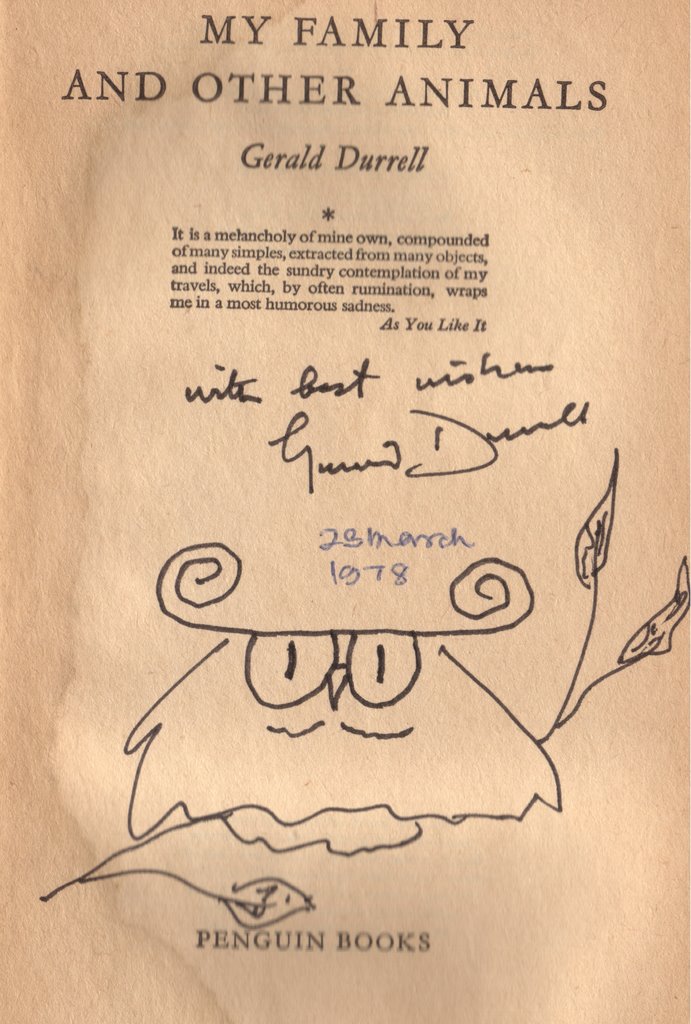 Durrell’s older brother, Lawrence (1912-1990) was born in Darjeeling, the stunning Himalayan town where I was educated. The elder Durrell even spent his early school years at St Joseph’s College in the Darjeeling outpost of North Point. A novelist, and playwright, Lawrence Durrell’s most famous work was (and still is) `The Alexandria Quartet (1957-60) which was considered his best shot at a Nobel Prize for literature.
During the interview, Gerald Durrell was quick to play down any hint of a comparison between him and his brother. ``Larry writes for posterity,’’ he told me, without a trace of irony, ``while I write to fund my expeditions and projects.’’ He was completely at ease, happy to talk about character portrayal in `My Family and Other Animals’ and quick to point out that the multi-skilled family retainer, Spiro, was still alive.
At the end of the interview, Durrell complimented me on the fact that I had done my homework before speaking to him. A trifle embarrassed, I then pointed out that I had read most of his books as a child and he clapped his hands in glee. This was a good time, I thought, to ask him if he would mind autographing the copy of `My Family’. No problem at all, he said.
He signed the book with a flourish. Then, before he handed it back to me, he swiftly sketched the owl that is reproduced here.
In truth, however, it was the young rookie journalist who thought the whole experience was quite a hoot.

Subscribe to:
Posts (Atom)